%20(5).png)

Milestones
Lower Elementary Program
Lower Elementary grades kindergarten through second grade immerse young learners in a structured, engaging environment where they build strong literacy skills through storytelling and phonics, sharpen mathematical reasoning with hands-on tools and real world problems, and cultivate emotional intelligence through guided reflection and teamwork. Clear grade-level benchmarks guide every interactive lesson and project, nurturing self-assurance, a spirit of exploration and a lasting love of learning.

At the kindergarten level, Louisiana standards foreground holistic readiness, integrating early learning domains with emerging academic content.
-
Print Concepts & Letter Recognition: Students hold books correctly, follow text directionality, and recognize and name all upper- and lowercase letters.
-
Phonological Awareness: Children recognize and produce rhymes, count and segment syllables in spoken words, and blend onsets and rimes in single-syllable words.
-
Phonics & Phonetic Spelling: Learners write letters to represent consonant and vowel sounds, and spell simple words phonetically to demonstrate grapheme–phoneme.
-
Comprehension & Expression: With prompting, students ask and answer questions about key details, retell familiar narratives, and link illustrations to text.
-
Emergent Writing: Drawing, dictating, and writing letters or letter clusters allow children to express ideas in writing.
Early Literacy
-
Counting & Cardinality: Kindergarteners count to 100 by ones and tens, write numerals to 20, and answer “how many?” questions by counting sets.
-
Operations & Equations: They engage in joining and separating object sets and represent simple addition/subtraction situations with objects or drawings.
-
Measurement & Geometry: Students describe measurable attributes (e.g., length), compare object sizes, and identify basic shapes in their environment.
Early Numeracy
-
Scientific Inquiry: Young learners observe the natural world, ask questions, and describe phenomena in age-appropriate terms.
Science Foundations
-
Social Understanding: Students begin to recognize their roles within family and community contexts, fostering early social studies awareness.
Social Studies Foundations
Socio-Emotional Learning
In kindergarten, every classroom activity is designed to cultivate cooperation, assertiveness, responsibility, empathy and self-control, guiding children toward positive peer interactions and emotional resilience. Kindergartners begin to navigate the classroom community by learning to share roles and materials, take turns, and invite peers to play. They start to name basic emotions, admit mistakes and apologize when prompted, recognize and respect differences among classmates, and practice waiting and persisting when tasks become challenging .

First grade standards in Louisiana amplify kindergarten foundations, prompting students to apply skills strategically and develop conceptual clarity.
Literacy
-
Reading Literature: Ask and answer questions about key details in text, retell stories including central messages, and describe characters, settings, and major events using key details.
-
Foundational Skills: Decode one-syllable words with long and short vowel patterns, recognize and read irregularly spelled high-frequency words, and begin reading grade-appropriate texts with fluency.
-
Writing: Compose opinion and narrative pieces with supportive details, using grade-appropriate conventions.
Numeracy
-
Addition & Subtraction: Develop understanding of addition and subtraction within 20, using strategies such as counting on or making ten.
-
Place Value: Grasp whole-number relationships and place value in tens and ones.
-
Measurement & Data: Compare lengths indirectly, organize and interpret data with up to three categories, and pose and answer questions about data sets.
Science
-
Structures & Processes: Use tools and materials to design a human problem solution by mimicking how plants and animals use external parts to survive and grow.
-
Heredity: Make observations to compare similarities and differences in external features between young organisms and their parents.
-
Behavioral Adaptations: Read texts and use media to identify patterns in behavior between parents and offspring that aid survival.
-
Patterns in the Sky: Use observations of the sun, moon, and stars to describe their predictable patterns of movement.
-
Seasonal Daylight: Make observations across seasons to compare daylight amounts and relate changes to Earth’s tilt and orbit.
Social Studies
-
Historical Thinking: Create chronological event sequences with appropriate vocabulary and differentiate between primary and secondary sources.
-
Evidence-Based Claims: Select and use relevant evidence from sources to construct and express supported claims.
-
Past vs. Present: Compare life in Louisiana’s past and present and describe how historical events affect the current community.
-
Civic Awareness: Describe Louisiana’s state government purpose and structure, identify its branches, and explain civic virtues such as fairness, responsibility, and respect.
-
Economic Concepts: Differentiate producers and consumers, explain scarcity, and identify goods, services, and natural resources in Louisiana.
-
Geographic Skills: Create and interpret maps and models using cardinal directions, keys, and scale; identify parishes, regions, and landforms in Louisiana.
Socio-Emotional Learning
In first grade, every learning opportunity is structured to reinforce cooperation, assertiveness, responsibility, empathy and self-control, empowering students to articulate feelings, support peers and regulate their behavior. First graders build on those foundations by explaining why they feel particular emotions, advocating for help when needed, and independently apologizing or accepting responsibility for their actions. They cooperate in more structured group roles, compromise toward shared goals, show empathy by including classmates who are different or excluded, and use self-regulation strategies like self-talk or deep breaths to stay on task.
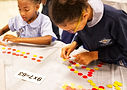
By the end of second grade, Louisiana learners consolidate literacy and numeracy skills while engaging with more complex texts and mathematical concepts.
Literacy
-
Reading Literature: Ask and answer who, what, where, when, why, and how questions to demonstrate understanding of key details.
-
Recount & Lesson: Recount stories—including fables and folktales—and determine their central message, lesson, or moral.
-
Fluency & Foundational Skills: Read with sufficient accuracy and fluency to support comprehension, decode two-syllable words, and recognize punctuation to guide phrasing.
Numeracy
-
Base-Ten Notation: Extend understanding to three-digit numbers, recognizing that digits represent hundreds, tens, and ones.
-
Addition & Subtraction Fluency: Build fluency within 100 through strategies grounded in place value and properties of operations.
-
Measurement & Data: Use standard units (centimeters, inches), tell and write time to the nearest five minutes, solve word problems involving money, and represent data graphically.
-
Geometry: Describe and analyze two- and three-dimensional shapes based on their attributes
Science
-
Biodiversity: Observe and compare plant and animal diversity across land and water habitats.
-
Rapid vs. Gradual Change: Use evidence from multiple sources to explain that some Earth events occur quickly (e.g., floods) while others happen slowly.
-
Erosion Solutions: Compare design solutions to slow or prevent wind and water from reshaping land, using models and data.
-
Landform Modeling: Develop models to represent the shapes and types of landforms and bodies of water in a given area.
-
Water Distribution: Obtain and communicate information to identify where water is found on Earth and in what states.
Social Studies
-
Historical Sequencing & Revolution: Create chronological sequences, differentiate sources, support claims, compare past and present U.S. life, describe the American Revolution’s significance, and identify founding figures and national symbols.
-
Civic Structure & Principles: Describe the three branches of the U.S. government, basic democratic principles from the Declaration of Independence and Constitution, and civic virtues like voting and volunteering.
-
Economic Foundations: Explain free enterprise, producers and consumers, costs and benefits, specialization, and how resources are used to produce goods and services.
-
Geographic Literacy: Create and use maps and models with keys, scale, and compass; describe U.S. and world geographic features, hemispheres, and relative locations.
-
Human–Environment Interaction: Identify major natural disasters and their impacts; explain how and why people, goods, and ideas move, including patterns of immigration.
Socio-Emotional Learning
At the Second grade level, lessons to prepare students for increasingly sophisticated interpersonal challenges.
By second grade, students resolve minor peer conflicts on their own and prioritize group objectives over personal preferences. They articulate complex feelings even in emotional moments and take initiative toward solutions, understand how their choices affect others , demonstrate kindness and respect across cultures , and connect effort with positive outcomes showing resilience when facing setbacks.
Upper Elementary Program
Where third through fifth graders turn questions into discoveries, our Upper Elementary program blends rigorous academics with real-world relevance across reading, writing, mathematics, science and social studies. Each lesson maps directly to clear grade-level benchmarks, ensuring learners master the precise skills they need, while teachers employ quick checks to measure understanding and share straightforward updates with families. This transparent partnership builds confidence and drives achievement.

In third grade, learners deepen their academic foundation by engaging directly with grade level texts, tackling more complex problems, and exploring scientific and social concepts through hands-on inquiry.
-
Comprehension & Inquiry: Ask and answer who, what, where, when, why, and how questions about key details in both narratives and informational texts.
-
Recount & Theme: Recount stories and determine their central message or lesson, using key details from the tex.t
-
Character & Point of View: Describe characters’ traits and analyze how a character’s point of view influences conflict.
-
Vocabulary in Context: Determine the literal and nonliteral meanings of words and phrases as they are used in text.
-
Fluency: Read at the high end of the Grade 2–3 complexity band independently and proficiently.
-
Writing: Produce opinion, informative, and narrative pieces with supporting details and appropriate structure.
English Language Arts
-
Operations & Algebraic Thinking: Interpret and solve products and whole-number quotients within 100, and identify arithmetic patterns.
-
Number & Place Value: Understand place value of hundreds, tens, and ones; add and subtract within 1,000 with regrouping.
-
Fractions: Understand a fraction 1/b and a/b as parts of a whole; use fraction models to recognize equivalence.
-
Measurement & Data: Measure lengths using rulers, tell and write time to the nearest minute, and represent data with bar graphs and pictographs.
-
Geometry: Identify and describe attributes of two- and three-dimensional shapes; partition shapes into equal parts.
Mathematics
-
Life Cycles: Develop models to describe birth, growth, reproduction, and death in organisms.
-
Forces & Motion: Investigate how forces affect motion and relate speed to energy in objects.
-
Earth Systems: Explain rapid events (e.g., landslides) versus slow processes (e.g., erosion) and model Earth’s surface changes.
-
Earth–Sun–Moon: Use observations to describe patterns of the Sun, Moon, and stars and seasonal daylight changes.
Science
-
Historical Thinking: Sequence events on timelines and distinguish primary from secondary sources in research.
-
Geography: Use cardinal directions, map keys, and scales to locate continents, oceans, and Louisiana landforms.
-
Civics: Identify citizen roles, rights, and responsibilities; explain functions of local government.
-
Economics: Differentiate producers and consumers; describe how goods and services are exchanged in markets.
-
Culture: Explore traditions and cultural contributions within Louisiana and diverse communities.
Social Studies
Socio-Emotional Learning
In third grade, lessons deepen self-awareness, self-management, social awareness, relationship skills and responsible decision-making to prepare students for more independent emotional and social challenges.
Learners in Grade 3 accurately identify and label their own emotions, apply coping strategies such as deep breathing to manage impulses, show empathy by considering peers’ perspectives, resolve minor conflicts with guided support, and reflect on choices and consequences in classroom tasks.

Fourth graders analyze texts for figurative language and organizational structures, draw inferences, and produce clear opinion, explanatory, and narrative pieces. In mathematics, they interpret multiplication as comparison, generate and operate with equivalent fractions, solve multistep word problems, and understand angle measure. Science studies focus on energy transfer, waves, organism structures, and weathering and erosion, while social studies explores ancient civilizations, mapping geographic influences, and the origins of government and economy.
English Language Arts
-
Vocabulary & Figurative Language: Determine meanings of general academic and domain-specific words, including metaphors and similes.
-
Text Structure: Explain differences among poems, drama, and prose; identify chronology, comparison, cause/effect, and problem/solution structures.
-
Inference & Evidence: Summarize texts, draw inferences, and cite supporting details from a variety of genres.
-
Writing: Produce organized opinion, explanatory, and narrative texts with clear supporting details.
-
Speaking & Listening: Engage effectively in collaborative discussions and present information clearly.
Mathematics
-
Multiplicative Comparisons: Interpret multiplication as comparison and solve word problems with two-digit factors.
-
Fraction Equivalence & Operations: Recognize and generate equivalent fractions; add and subtract fractions with like denominators.
-
Measurement & Data: Represent and interpret data; understand angle measure as a geometric attribute.
Science
-
Energy & Motion: Explain how the speed of an object relates to its energy and demonstrate energy transfer by sound, light, heat.
-
Waves & Signals: Investigate how sound and light carry energy through mediums.
-
Organism Structures: Model how plant and animal parts function to survive and grow.
-
Earth Systems: Examine weathering, erosion, and how natural resources shape the land.
Social Studies
-
Ancient Civilizations: Analyze political, cultural, and economic characteristics of Mesopotamia, Egypt, and other early societies.
-
Geographic Skills: Map ancient world features; explain how physical geography influenced settlement.
-
Government & Law: Describe roles of rulers and laws in early governments and draw connections to modern structures.
-
Trade & Economy: Explain barter systems, the development of currency, and resource distribution.
-
Cultural Achievements: Compare advances in writing, architecture, and arts across ancient cultures.
Socio-Emotional Learning
In fourth grade, our curriculum intentionally weaves self-awareness, self-management, social awareness, relationship skills, and responsible decision-making into each learning experience, equipping students to take ownership of their growth and collaborate effectively.
By Grade 4, students articulate their strengths and set personal learning goals, plan and monitor steps to complete projects, appreciate diverse cultural perspectives, lead small-group collaborations and mediate peer disagreements, and evaluate ethical dimensions of choices in classroom scenarios.

In fifth grade, learners integrate and apply knowledge by synthesizing complex texts, mastering advanced calculations, designing scientific models and tracing U S history from exploration through Reconstruction..
English Language Arts
-
Analysis & Evidence: Compare and contrast characters, settings, and events; cite textual evidence from literature and informational texts.
-
Theme & Point of View: Determine theme, analyze author’s purpose, and evaluate how point of view shapes text meaning.
-
Research & Synthesis: Integrate information from multiple sources to build and present knowledge on a topic.
-
Advanced Writing: Compose opinion, explanatory, and narrative texts with multimedia and technology.
-
Language Conventions: Master complex grammar, punctuation, and vocabulary to enhance clarity and style.
Mathematics
-
Operations & Algorithms: Fluently multiply multi-digit numbers and divide up to four-digit dividends by two-digit divisors.
-
Fraction & Decimal Operations: Add/subtract fractions with unlike denominators; interpret and perform operations with decimals.
-
Coordinate Geometry: Plot points in the coordinate plane and classify shapes by properties.
-
Measurement & Data: Convert units, calculate volume of prisms, and analyze data distributions.
Science
-
Matter & Microstructures: Model particles of matter and predict changes from mixing or reactions.
-
Energy Flow: Describe that energy in food originates from the sun and trace energy flow in ecosystems.
-
Space Science: Support arguments about the apparent brightness of stars based on distance and light properties.
-
Earth Systems: Investigate human impacts on Earth’s systems and propose solutions to environmental challenges.
Social Studies
-
U.S. History: Trace American history from early exploration through Reconstruction, highlighting key events and figures .
-
Civics & Government: Explain the Constitution, Bill of Rights, and the three branches of government and their functions.
-
Economics: Analyze supply and demand, market systems, and the role of specialization and trade in the U.S. economy.
-
Geographic Inquiry: Use maps and spatial data to describe U.S. regions, resources, and population patterns.
-
Cultural Diversity: Examine contributions of diverse groups to U.S. culture, traditions, and civic life.
Socio-Emotional Learning
In fifth grade, students deepen their social–emotional toolkit, learning to connect emotions with choices, support others, and uphold their values in complex situations.. At Grade 5, learners reflect on how their emotions influence decisions and set strategies to manage stress, advocate for peers and demonstrate kindness across differences, facilitate group work and resolve conflicts independently, and resist negative peer pressure by weighing long-term consequences.
Middle School Program
Lower Elementary grades kindergarten through second grade immerse young learners in a structured, engaging environment where they build strong literacy skills through storytelling and phonics, sharpen mathematical reasoning with hands-on tools and real world problems, and cultivate emotional intelligence through guided reflection and teamwork. Clear grade-level benchmarks guide every interactive lesson and project, nurturing self-assurance, a spirit of exploration and a lasting love of learning.

By sixth grade, students independently cite textual evidence to analyze complex literature and informational texts, determining themes and central ideas; extend mathematical reasoning to solve real-world ratio and rate problems involving unit rates; develop and use scientific models of atomic and molecular structures and apply Newton’s Third Law in experimental design; and use geospatial skills along with primary/secondary-source analysis to interpret geographic and historical contexts.
-
Comprehension & Inquiry: Ask and answer who, what, where, when, why, and how questions about key details in both narratives and informational texts.
-
Recount & Theme: Recount stories and determine their central message or lesson, using key details from the tex.t
-
Character & Point of View: Describe characters’ traits and analyze how a character’s point of view influences conflict.
-
Vocabulary in Context: Determine the literal and nonliteral meanings of words and phrases as they are used in text.
-
Fluency: Read at the high end of the Grade 2–3 complexity band independently and proficiently.
-
Writing: Produce opinion, informative, and narrative pieces with supporting details and appropriate structure.
English Language Arts
-
Operations & Algebraic Thinking: Interpret and solve products and whole-number quotients within 100, and identify arithmetic patterns.
-
Number & Place Value: Understand place value of hundreds, tens, and ones; add and subtract within 1,000 with regrouping.
-
Fractions: Understand a fraction 1/b and a/b as parts of a whole; use fraction models to recognize equivalence.
-
Measurement & Data: Measure lengths using rulers, tell and write time to the nearest minute, and represent data with bar graphs and pictographs.
-
Geometry: Identify and describe attributes of two- and three-dimensional shapes; partition shapes into equal parts.
Mathematics
-
Life Cycles: Develop models to describe birth, growth, reproduction, and death in organisms.
-
Forces & Motion: Investigate how forces affect motion and relate speed to energy in objects.
-
Earth Systems: Explain rapid events (e.g., landslides) versus slow processes (e.g., erosion) and model Earth’s surface changes.
-
Earth–Sun–Moon: Use observations to describe patterns of the Sun, Moon, and stars and seasonal daylight changes.
Science
-
Historical Thinking: Sequence events on timelines and distinguish primary from secondary sources in research.
-
Geography: Use cardinal directions, map keys, and scales to locate continents, oceans, and Louisiana landforms.
-
Civics: Identify citizen roles, rights, and responsibilities; explain functions of local government.
-
Economics: Differentiate producers and consumers; describe how goods and services are exchanged in markets.
-
Culture: Explore traditions and cultural contributions within Louisiana and diverse communities.
Social Studies
Socio-Emotional Learning
Sixth graders begin to articulate their own emotions and identify personal strengths and areas for growth (Self-Awareness). They employ stress-management strategies, such as deep breathing and goal-setting, to regulate impulses and stay focused during academic tasks (Self-Management). Students demonstrate empathy by recognizing classmates’ perspectives and show respect for diverse backgrounds (Social Awareness). They collaborate effectively, actively listening and communicating to negotiate group roles and responsibilities (Relationship Skills). Finally, they reflect on choices and consider consequences before acting, demonstrating growing accountability in both classroom and social setting.

By seventh grade, learners cite multiple pieces of evidence to support analyses of explicit and inferred ideas in both literary and informational texts; recognize and represent proportional relationships and solve multi-step ratio, percent, and rational-number problems; analyze and interpret data on substance properties to identify chemical reactions and plan investigations of energy transfer; and evaluate primary and secondary sources to construct evidence-based historical claims about early U.S. political developments.
English Language Arts
-
Textual evidence & inference: Cite multiple pieces of text to support analysis of explicit and inferred ideas.
-
Vocabulary & tone: Determine meanings of words/phrases (figurative, connotative, technical) and analyze impact of specific word choices on meaning and tone.
-
Narrative elements: Analyze how story or drama elements (e.g., setting, plot devices) interact to advance action and develop characters.
-
Media comparison: Compare and contrast a written text to its audio, filmed, staged, or multimedia version, analyzing each medium’s portrayal.
-
Argument evaluation: Trace and evaluate arguments and claims in texts, assessing reasoning soundness and evidence relevance/sufficiency.
-
Research & citation: Conduct short research projects using multiple sources, assess credibility, avoid plagiarism, and cite sources
Mathematics
-
Unit rates with fractions: Compute unit rates for ratios of fractions in varied contexts.
-
Proportional reasoning: Recognize and represent proportional relationships; solve multi-step ratio and percent problems.
-
Rational operations: Add, subtract, multiply, and divide rational numbers, including positive/negative values and fractions.
-
Algebraic expressions: Apply properties of operations to add, subtract, factor, and expand linear expressions with rational coefficients .
-
Statistical inference: Determine sample sizes and use random samples to draw inferences about populations.
Science
-
Chemical reactions: Analyze and interpret data on substance properties before/after interactions to determine chemical reactions and conservation of mass.
-
Thermal energy investigations: Plan investigations relating energy transfer to particle motion and temperature for different masses.
-
Earth systems & climate: Use models to explain sea and land breezes, climate variation by latitude/altitude, and ask questions about human-driven global temperature changes.
. -
Biological organization: Use evidence-supported arguments to describe the body as interacting subsystems of cells, and model photosynthesis/cellular respiration in matter/energy cycling.
-
Ecosystem dynamics: Design projects and construct arguments showing how changes to ecosystems affect biodiversity and services.
Social Studies
-
Chronological U.S. history: Explain major U.S. events from early republic through Reconstruction (1791–1877), including Louisiana Purchase, War of 1812, westward expansion, sectionalism, Civil War, and Reconstruction.
-
Global context analysis: Analyze connections between U.S. history and global events/developments.
-
Comparative evaluation: Compare and contrast events, developments, and divergent perspectives.
-
Geographic tools: Use maps and geographic data to analyze historical events’ environmental, cultural, economic, and political characteristic.
-
Source-based claims: Employ primary/secondary sources to analyze content, evaluate evidence, compare accounts, and construct evidence-based claims.
Socio-Emotional Learning
By seventh grade, learners deepen self-understanding by reflecting on personal biases and how emotions influence decisions (Self-Awareness). They plan and monitor multi-step academic projects, using organizational tools and coping strategies to manage stress over longer timelines (Self-Management). Students practice empathy at a complex level, considering cultural and situational contexts when responding to peers (Social Awareness). They mediate peer conflicts and facilitate group discussions with minimal teacher intervention, showcasing advanced communication and collaboration (Relationship Skills). Additionally, they evaluate ethical dimensions of choices in academic and social scenarios, weighing short-term benefits against long-term impacts (Responsible Decision-Making)

By eighth grade, students cite the most relevant evidence to analyze explicit and inferred ideas, trace theme development, and compare text structures across complex literary and informational texts; work confidently with irrational numbers and integer exponents, apply scientific notation, and model linear functions and geometric calculations including transformations and volume computations; design and test devices to control thermal energy transfer and construct explanations for geologic time-scale events using rock-strata evidence; and analyze U.S. history from Reconstruction through modern times using geographic data and source-based reasoning to assess patterns of continuity and change.
English Language Arts
-
Strong textual evidence: Cite the evidence that most strongly supports analysis of explicit and inferred ideas.
-
Theme development: Determine a theme’s development over a text, including its relation to characters, setting, and plot; provide an objective summary.
-
Dialogue & plot analysis: Analyze how lines of dialogue or incidents propel action, reveal character aspects, or provoke decisions.
-
Comparative structure: Compare structures of two or more texts and analyze how differing structures contribute to meaning and style.
-
Argument evaluation: Delineate and evaluate arguments and claims in texts, assessing reasoning and evidence quality.
-
Research fluency: Conduct short research projects drawing on multiple sources, assess credibility, and provide bibliographic details.
Mathematics
-
Irrational numbers: Identify and approximate irrational numbers (e.g., π, √2); use decimal expansions and locate on number lines
-
Exponents & radicals: Apply properties of integer exponents to generate equivalent expressions (8 .EE .1) and solve equations using square/cube roots.
-
Linear models & functions: Write equations of lines (y = mx; y = mx + b), distinguish functions vs non-functions, and compare properties across representations.
-
Geometry & volume: Verify transformations’ properties; recognize congruent/similar figures; compute volumes of cubes, spheres, and cylinders.
. -
Data association: Construct and interpret scatter plots to investigate patterns of association between two variables.
Science
-
Molecular models: Develop models describing atomic composition of molecules and structure.
-
Thermal energy devices: Design, construct, and test devices to control thermal energy transfer; argue how kinetic-energy changes transfer energy.
-
Geologic history: Construct explanations from rock-strata evidence for the geologic time scale and model Earth’s material/energy cycling.
-
Resource distribution: Explain uneven distributions of Earth’s resources based on past/current geoscience processes and evaluate human-impact solutions.
-
Biological systems & evolution: Construct arguments explaining how organism structures/functions and genetic changes affect growth, behavior, and evolution; analyze fossil-record pattern.
Social Studies
-
Modern U.S. history: Explain and analyze U.S. events from 1877 to 2008, assessing progression, continuity, and change.
-
Global context: Analyze connections between U.S. developments and global events from.
-
Geographic analysis: Use geographic data and maps to analyze events’ environmental, cultural, economic, and political aspects.
-
Source evaluation: Apply primary/secondary-source analysis to evaluate claims, compare accounts, and explain interpretation effects.
-
Thematic inquiry: Investigate themes of industrialization, world wars, economic crises, political/social reforms, and modern movements through a Louisiana lens.
Socio-Emotional Learning
Eighth graders articulate nuanced emotions and connect them to long-term academic and personal goals, demonstrating sophisticated self-reflection (Self-Awareness). They independently manage complex assignments, balancing competing demands and adapting strategies to overcome setbacks (Self-Management). Learners advocate for inclusive practices, recognizing systemic factors that influence peers’ experiences (Social Awareness). They assume leadership roles in collaborative projects, guiding teams and resolving conflicts to achieve collective objectives (Relationship Skills). Finally, they demonstrate mature decision-making, analyzing ethical considerations in academic integrity and social interactions and taking responsibility for outcomes (Responsible Decision-Making)